


EPP foam helmet liner or EPS foam helmet liner for Helmet?
Current helmets mostly perform energy management with foam of some type, although better materials are coming. There are many different types and grades of foam. There are two major categories of helmet foam: some foams are stiff and crushable, while other foams are rubbery or squishy. Their characteristics make it possible to design a helmet for one very hard impact, a number of hard impacts, or a very large number of softer impacts. But each foam has its limitations.
All foams have some common characteristics. Generally they are all cheap to manufacture. Because they have jillions of air cells incorporated in them, they are all good insulators. That means that most helmets will have to have some air circulation inside the helmet to prevent heat buildup unless the weather is very cold. And all foams will immediately or eventually deteriorate under impact, even though some can take multiple impacts before deterioration sets in.

The crush or deformation of foams can be varied by changing their density. Denser foams resist very hard impacts better before compressing or crushing to their ultimate limit and "bottoming out," passing all the rest of the impact energy on to the head. Softer foams compress, deform or crush more easily in lesser impacts, giving better protection against the milder injuries we call concussions. A helmet can have both types of foam in layers, but that usually increases the thickness.
The slowing of the head is dependent on the foam characteristics and on the foam thickness. The best foam for your crash provides an optimal rate of crush or deformation for the particular impact you are experiencing. If that foam is one inch thick it gives you longer to stop in a very hard impact than foam that is one half inch thick. If it is a less dense foam, it can give you a softer landing in a lesser impact, and if it is thicker it can do that without bottoming out in a hard one. But when helmets get too thick, they look like a mushroom on the rider's head, and consumer acceptance drops like a stone. In addition, thicker helmets that stick out farther from the head might possibly add to "rotational" injuries by jerking the head around more in a skidding impact.
In short, the ideal foam is just thick enough for your crash impact, and just firm enough to minimize your g's without bottoming out. Since you don't know exactly what your impact will be, the ideal foam would adapt for each blow. That's a "rate-sensitive" foam that stiffens in major impacts but cushions more in lesser impacts.

Crushable Foams
Crushable foams are ideal for helmets designed for one hard impact. The cell walls crush on impact and slow the head gradually. A small portion of the energy is converted to heat as noted above. When foam crushes, it does not bounce back at the bottom like a spring to make the impact worse. But when you reach its crush limit, it will pass the rest of the impact energy straight through to your head.
One of the major design parameters of every helmet is the specification of foam density. That is what "tunes" the helmet for a specific range of impacts. High density for harder impacts, lower density for a softer landing but with the possibility of bottoming out in a hard blow. With experience you can make a guess at the density of a foam by squeezing it with your thumb enough to make a small impression. (Don't do this with a helmet somebody will be wearing!)
Crushing the cell walls destroys the impact management ability for most stiff foams, so the helmet has to be replaced after a single impact. The crushing is not always visible and can be hidden by the outer shell. The foam can also recover some of its thickness over a period of hours, but not its ability to manage impact. Crushed and partially recovered one-use foam will feel rubbery and soft. Experts measure the foam thickness carefully for crush, but for consumers the recommendation has to be "replace after every impact." Often the damage is not apparent in a casual inspection, even when there are cracks in the foam. And the rider often underestimates the impact because crushing of the foam dampened the shock.
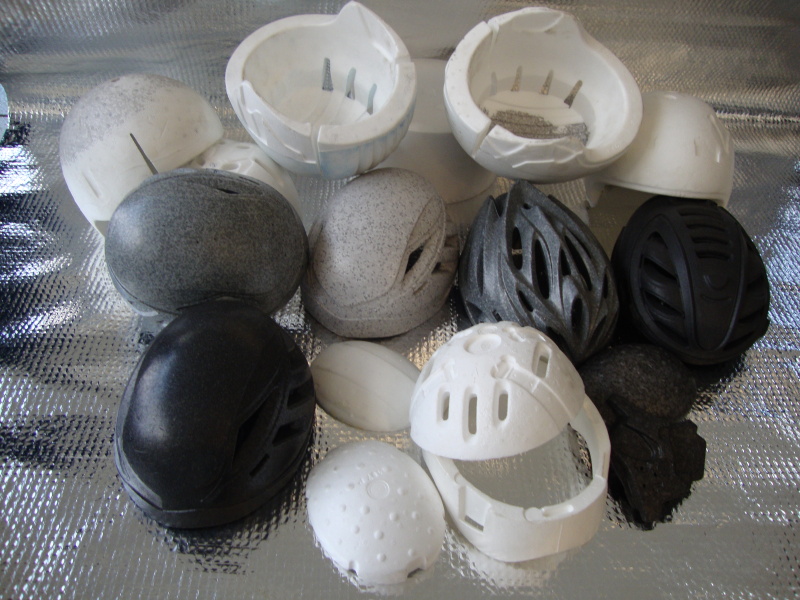
Some crushable foams:
EPS Expanded PolyStyrene is one of the most widespread foams used in our society. It is the white picnic cooler foam that you see eggs and stereo gear packed in. It is the peanuts in your mail order package. It is the white food carton or drink cup you get at a carry-out. It is cheap to manufacture, light, and has almost ideal crush characteristics with no bounce-back to make the impact more severe. It can be reliably manufactured with reasonable quality control procedures.
EPS is formed by placing polystyrene beads (granules) about the size of table salt in a pressure mold shaped like the helmet liner and expanding the bead from 2 to 50 times with a blowing agent like pentane under pressure and heat. The beads expand to form the cells and fill the mold. The cells are tightly bonded--under ideal conditions. Under poor conditions the steam/pentane temperature is not just right or the pressure is off a little and the foaming may not be uniform, or there may be hidden recesses where the granules did not expand correctly. (A helmet liner with such a recess "rattles" with unexpanded beads inside when shaken.) The foaming is often done by a "foam shop" outside the manufacturer's plant, and the challenge for helmet quality control programs is to design testing that will catch any problem liners. Foam density is measured by weighing the liner, then placing it in water and weighing the amount of water displaced, and comparing the two weights.
The version of EPS you see in a helmet is several quality grades above what normally is used for picnic coolers. It can be tuned to produce optimal crush for a given impact level by varying the density of the foam cells. Additives can provide increased cell adhesion, cutting down the splitting of helmets in very hard impacts. Additives can also be used to color the foam, although they may change the impact characteristics. Manufacturers can add internal reinforcing using nylon, carbon fiber or various types of plastics to reduce cracking as well, enabling designers to open up wider vents and still pass the lab impact tests.
Molding techniques for EPS have evolved over the half century that it has been used for helmets, enabling manufacturers to push the envelope by producing a helmet liner with harder and softer foam in layers (variable density foam). That lets the softer inner layer of foam crush in a lesser impact, where harder foam would just resist and pass the energy on to the head. The harder outer layer is still there when the soft foam bottoms out to keep managing the energy in a hard impact. Over the years there have been several helmets that used this technique.

EPS is not generally recycled in helmets, since the quality control problems would be multiplied. In fact, it is difficult to get your old helmet to a foam recycler without wasting more fossil fuel resources than recycling the helmet can save.
EPP Expanded PolyPropylene is very similar in appearance to EPS, with just a touch of rubbery feel on the surface by comparison and a little bit of give if you squeeze it with your thumb. EPP is a multi-impact foam, recovering its shape and most of its impact protection slowly after a crash. It can be trickier to work with than EPS, costs a little more, and has a higher amount of rebound (in technical terms a less favorable coefficient of restitution) that usually requires a little bit thicker helmet than one using EPS. Most of the rebound takes place after test rigs have stopped measuring the impact severity, so that characteristic is not well documented. EPP looks identical to EPS, and only the label can tell you if your helmet has this multi-impact foam or the one-use-only EPS. There are some, but not many, EPP helmets on the market, mostly for multi-impact sports like skateboarding.
Although there are many types of foams available, EPS remains the choice for most bike helmets because it performs well in hard impacts and it is light, cheap, durable in use, reliable to manufacture and easy to ventilate. A rate-sensitive foam would probably permit better protection against the lesser impacts where most of today's bike helmets are too stiff because they have to provide protection against catastrophic brain injury in very hard impacts, but has other drawbacks. Research continues, and new foams appear from time to time, but for the present they all have disadvantages that keep them from replacing EPS. The use of plastic constructs and 3d printing with new designs and materials seems to offer the most potential for future gains in both low-energy protection and rotational energy management.

Though it looks identical to crushable EPS foam, expanded polypropylene (EPP) is a more resilient crushable foam, which is to say that it slowly regains its shape following an impact and retains some of its protective quality. For that reason, EPP can be integrated into helmets designed to help protect users from multiple impacts. It has seen use, for example, in skateboarding helmets. EPP is most commonly used in the automobile industry, where it can be found into products such as bumper bars, sun visors, roof pillars, armrests and headrests.
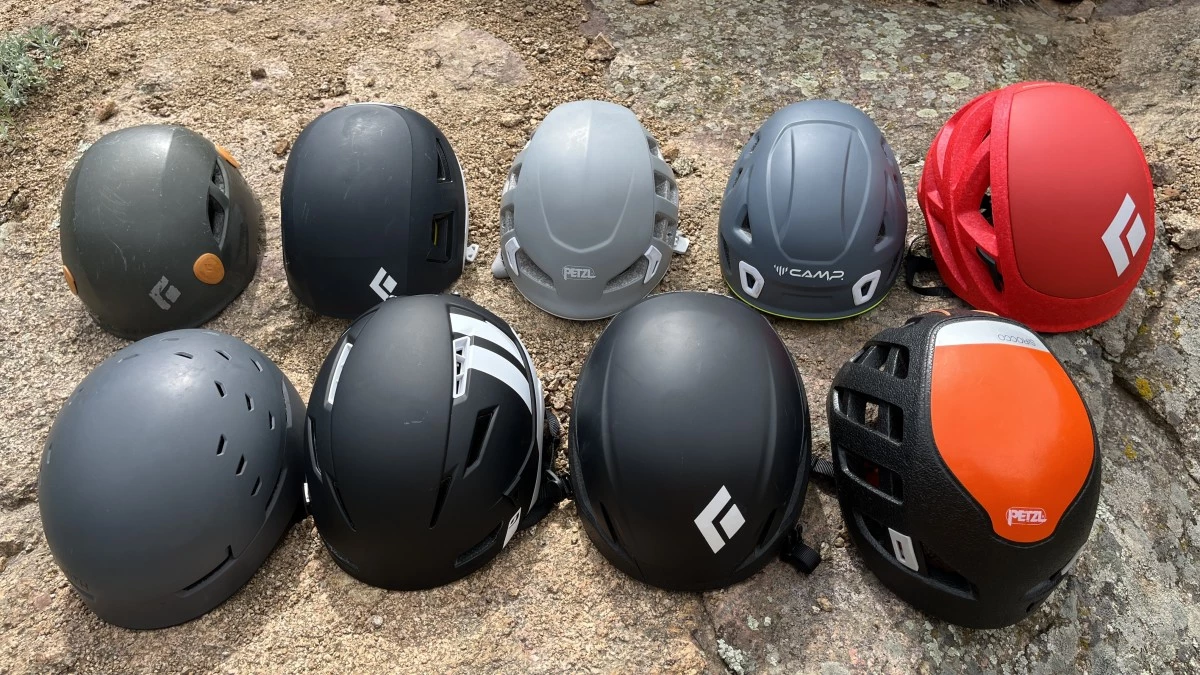
Though EPP could be an attractive liner material for certain cycling enthusiasts, this particular type of foam generally isn’t utilized for cycling helmets. The reason? EPP offers slightly less impact attenuation for a given thickness than EPS foam, which means that more EPP foam must be employed to provide the same level of energy management. The end result would be a heavier and thicker helmet—both traits are “hard sells” in the cycling, snow sports and motorcycle markets.


